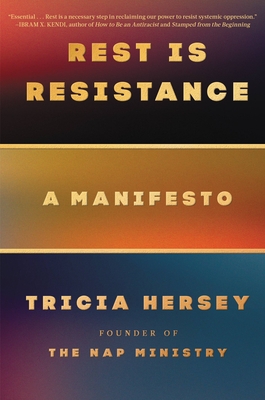
Tricia Hersey’s book Rest is Resistance: A Manifesto is one of those books that could have been a blog post… almost. Her urgent and important thesis statement is that downtime is essential to human flourishing, and that capitalism systematically opposes both the downtime and the flourishing. But many of her supporting points and implications of her thesis are left undeveloped. This leaves a lot of space for Hersey to restate her main idea with slight changes in phrasing1. I got the sense her message would have been better suited to a smaller format. Except you could probably argue (and I’d probably believe) that this repetition serves to reinforce her point that learning to rest, or “deprogramming from grind culture” as she puts it, will be a long, slow process.
The idea that rest is critical for human well-being is probably obvious when framed in terms of actual nocturnal sleep. But Hersey suggests, persuasively, that daydreaming, softness, napping, and inactivity are also extremely important. She justifies these ideas with appeals to religious faith, saying that human beings are divine. Naps, she says, are part of our birthright. By contrast, systems that deny our divinity (and our humanity) by treating us like machines are evil.
Hersey doesn’t make any attempt to redress her ideas for secular readers. (If you believe, as I do, that human life is intrinsically valuable then her ideas are pretty easy to take, regardless of your religion.) Her imagined audience appears to be people who already mostly agree with her, but who might have overlooked the importance of rest. In this way, calling her book a manifesto makes sense. It’s a statement of belief rather than a piece of persuasive writing.
That’s disappointing, because there are some ideas I wanted to see explored further. Hersey makes claims like “perfectionism… is a function of white supremacy” and “capitalism was created on plantations.” I’m open to the possibility that there are ways in which these claims are true. But there are also obvious ways in which they’re false, and without further clarification it’s hard to simply accept them and move on.

Hersey is keenly aware of the ways her ideas are likely to be commodified and de-politicized. At times she seems short on practical recommendations about how to incorporate rest. This is at least partially because, as she repeatedly emphasizes, rest is going to look different for everyone and learning how to do it will be lifelong process2. These canny predictions of how her message will be misused were some of the things I admired most about Hersey’s writing. In addition to the above, she entreats reads to keep racial justice at the center of the rest movement. She also clarifies that taking naps is absolutely not about returning to work with renewed energy. Napping and resting are things we do only for ourselves, not to become more productive for bosses.
Tricia Hersey’s book grew out of her work creating The Nap Ministry. Check out their website and read a few of their blog posts. If you still feel like you want more, maybe the book is helpful after all.
- These slight changes in phrasing can still be helpful. For most of the book, Hersey identifies the enemy of rest as jobs, capitalism, and “grind culture.” But a couple times she mentions to-do lists, e.g. ““I know that if I never check another item off my to-do list, I am still worthy.” This shift allowed me to apply her message to productivity mandates I put on myself, and not just those that come from outside. ↩︎
- At one point she does share a list of 20 suggestions of what “resting can look like.” I was immediately struck by how the list format departed from her thoughtful, generally poetic prose and instead felt like a shallow facebook meme (indeed, she says the list was shared hundreds of thousands of times on social media). ↩︎
Leave a Reply