Tag: black lives matter

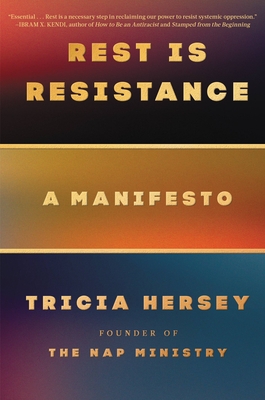
Book Review: Rest is Resistance: A Manifesto, by Tricia Hersey

Tricia Hersey’s book Rest is Resistance: A Manifesto is one of those books that could have been a blog post… almost. Her urgent and important thesis statement is that downtime is essential to human flourishing, and that capitalism systematically opposes both the downtime and the flourishing. But many of her supporting points and implications of her thesis are left undeveloped. This leaves a lot of space for Hersey to restate her main idea with slight changes in phrasing1. I got the sense her message would have been better suited to a smaller format. Except you could probably argue (and I’d probably believe) that this repetition serves to reinforce her point that learning to rest, or “deprogramming from grind culture” as she puts it, will be a long, slow process.

The idea that rest is critical for human well-being is probably obvious when framed in terms of actual nocturnal sleep. But Hersey suggests, persuasively, that daydreaming, softness, napping, and inactivity are also extremely important. She justifies these ideas with appeals to religious faith, saying that human beings are divine. Naps, she says, are part of our birthright. By contrast, systems that deny our divinity (and our humanity) by treating us like machines are evil.

Hersey doesn’t make any attempt to redress her ideas for secular readers. (If you believe, as I do, that human life is intrinsically valuable then her ideas are pretty easy to take, regardless of your religion.) Her imagined audience appears to be people who already mostly agree with her, but who might have overlooked the importance of rest. In this way, calling her book a manifesto makes sense. It’s a statement of belief rather than a piece of persuasive writing.

That’s disappointing, because there are some ideas I wanted to see explored further. Hersey makes claims like “perfectionism… is a function of white supremacy” and “capitalism was created on plantations.” I’m open to the possibility that there are ways in which these claims are true. But there are also obvious ways in which they’re false, and without further clarification it’s hard to simply accept them and move on.

Hersey is keenly aware of the ways her ideas are likely to be commodified and de-politicized. At times she seems short on practical recommendations about how to incorporate rest. This is at least partially because, as she repeatedly emphasizes, rest is going to look different for everyone and learning how to do it will be lifelong process2. These canny predictions of how her message will be misused were some of the things I admired most about Hersey’s writing. In addition to the above, she entreats reads to keep racial justice at the center of the rest movement. She also clarifies that taking naps is absolutely not about returning to work with renewed energy. Napping and resting are things we do only for ourselves, not to become more productive for bosses.

Tricia Hersey’s book grew out of her work creating The Nap Ministry. Check out their website and read a few of their blog posts. If you still feel like you want more, maybe the book is helpful after all.

  1. These slight changes in phrasing can still be helpful. For most of the book, Hersey identifies the enemy of rest as jobs, capitalism, and “grind culture.” But a couple times she mentions to-do lists, e.g. ““I know that if I never check another item off my to-do list, I am still worthy.” This shift allowed me to apply her message to productivity mandates I put on myself, and not just those that come from outside. ↩︎
  2. At one point she does share a list of 20 suggestions of what “resting can look like.” I was immediately struck by how the list format departed from her thoughtful, generally poetic prose and instead felt like a shallow facebook meme (indeed, she says the list was shared hundreds of thousands of times on social media). ↩︎

Review: The Wretched of the Earth, by Frantz Fanon

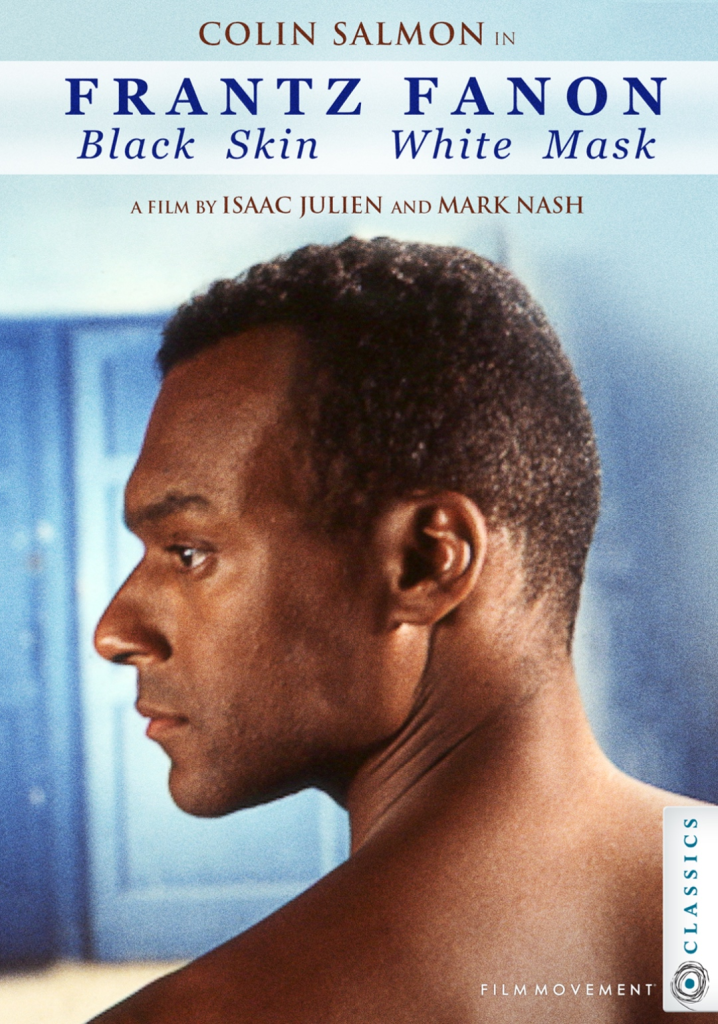
I think I first learned about Frantz Fanon several years ago when a documentary about him (which I still haven’t seen) hit the Criterion Channel. Traditional psychology has generally been pretty bad about considering black folks, and I’ve been interested for a while in the intersection of mental health and black culture in movies. Fanon, I learned from the movie description, was a black man and a psychiatrist, born in Martinique and educated in Paris. He went on to do much of his work in Algeria during their bloody fight for independence from France.

Reading more about Fanon, I found he was almost always described with words like “important” and “influential,” especially for his ideas on racial identity and decolonization. I had just finished a graduate program in psychology a few years before, and one that took every opportunity to brag about its emphasis on diversity. But despite this, I had never heard of Frantz Fanon! My curiosity was piqued.

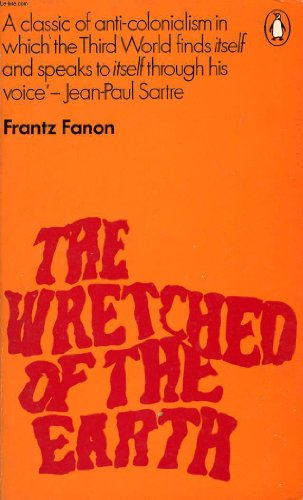
More recently, I stumbled across a comment that his book “The Wretched of the Earth” set out an argument that justified violence by colonized people against their oppressors. (Side note: I didn’t actually find any such argument in the book, though Fanon does take for granted that it’s ok for people to use violence to liberate themselves from an oppressive situation). With my curiosity newly inflamed, I got my hands on a copy of the audiobook, translated by Constance Farrington, and started listening.

Almost at once my interest evaporated. The book is front-loaded with embarrassingly bad anthropology. Fanon seems to suggest that colonized people (all colonized people, regardless of time or place) do things like dance or believe in ghosts because of some psychic conflict that’s wrought by colonialism. This obviously ignores the fact that some of these traditions very likely predate colonialism.1 (I’m not a historian or an anthropologist, so please correct me if I’m wrong).

It’s also emblematic of my main complaint about the book. Fanon talks in grand, sweeping generalizations. All colonial powers have the same agenda, all colonized people have the same experience, all cities are one way, and all rural areas another. Occasionally he will refer to specific examples, but he doesn’t seem to care about arguing his point beyond simply stating it. He almost never cites other thinkers (whether they agree or disagree) and certainly never incorporates quantitative evidence. He just rambles on and on, claiming this and that, and apparently assuming his ideas will be accepted without further question.

Fanon was a Marxist, and his tendency towards generalizations is characteristic of the few other Marxist writers I’ve read, especially around this period. They seem impressed with their theory of the world and uninterested or unaware that others might need convincing2.

It’s also an odd fit for Fanon’s other ideological stances. Psychology, as opposed to, say, sociology, is very interested in the particulars of individual people. One of the few interesting parts of the book were the psychiatric case studies of individuals suffering under colonialism. This is one of the only places where Fanon allows himself to zoom in to the particulars.

But also, Fanon argues persuasively against the idea of a general African or black culture. This idea, says Fanon, actually plays into the colonial mindset. It was white outsiders who came in and essentialized everyone as “black” without paying any attention to differences in culture and history. Despite making this point very well, he continues to talk about colonized people as if there were one solution that would serve all of them.

I glazed over for much of the book. The Wikipedia article is probably a much better resource if you’re interested in Fanon’s ideas. (It also shows that others were able to get much more out of the book than I was). But I did want to end by highlighting a couple of quotes and ideas from the text that I really appreciated3.

“It is commonly thought with criminal flippancy that to politicize the masses means from time to time haranguing them with a major political speech… But political education means opening up the mind, awakening the mind, and introducing it to the world. It is as Césaire said: ‘To invent the souls of men.’ It means driving home to the masses that everything depends on them, that if we stagnate the fault is theirs, and that if we progress, they too are responsible, that there is no demiurge, no illustrious man taking responsibility for everything, but that the demiurge is the people and the magic lies in their hands and their hands alone. In order to achieve such things, in order to actually embody them, we must, as we have already mentioned, decentralize to the utmost.”

Out of context this almost sounds like a call for anarchism! But Fanon quickly goes on to assert that his system would still have hierarchy. It’s just that the “upper echelons” would understand that their work depends on the work of the “rank and file.” Still, I like the point that if you want somebody to have more political consciousness, it’s not enough to occasionally talk at them.

“A memorable example, and one that takes on particular significance because it does not quite involve a colonial reality, was the reaction of white jazz fans when after the Second World War new styles such as bebop established themselves. For them jazz could only be the broken, desperate yearning of an old “Negro,” five whiskeys under his belt, bemoaning his own misfortune and the racism of the whites.”

I don’t know anything about jazz, but I do know about movies, this reminds me of some of the conversations around “black tragedy porn.” The overwhelmingly white film ecosystem will sometimes congratulate itself for making the occasional film about black people. But even when these films aren’t outright racist, and even when they don’t feature white saviors or other problematic tropes, they often heavily emphasize the tragedies that black people face due to racism. So even among white people willing to acknowledge racism, there are still ways to get it wrong.

Anyway, that’s all for now. I didn’t like this book, though it led me to some interesting ideas. We’ll see if I ever get around to that documentary about Fanon’s life.

  1. Fanon does have seem to have a larger theory about history that I failed to fully grok. Something about how utterly colonialism reshaped people’s lives, and what this means for formerly colonized folks who try to create their own culture. Maybe if I better understood this theory I’d have less objection to his seemingly bad anthropology. ↩︎
  2. Not trying to knock Marxists in general! A lot of Marxists have done really cool things! But I don’t think mid-20th century nonfiction writing is a good place to start engaging with them. ↩︎
  3. Unfortunately these are from a different translation. I couldn’t find an easy to access, online version of Farrington’s translation, which I prefer, at least based on the phrasing in these quotes. ↩︎