Tag: literature

Thoughts on Brave New World, by Aldous Huxley

I’m not calling this one a review because it’s a little less organized and might work better if you’ve already read the book. Still, it’s spoiler-free.

I recently finished reading Brave New World with some friends, and one of the things that stood out to me was the difficulty I had mapping the ideas onto contemporary politics. It seems like almost all media these days can be neatly collapsed into one of a few political ideologies. It’s clear, often before you even read/watch it, if a modern story is pro-trans or anti-vaccines or whatever, and such positions are generally accepted as indicating a standard package of other beliefs, typically “liberal” or “conservative.” People might sometimes miss the point (the shameful kerfuffle around “I Sexually Identify as an Attack Helicopter” comes to mind) but the pattern remains.

There’s probably an urge to blame such clearly blatant politics on declining media literacy, or political polarization, or some other buzzy trend1. And maybe that’s what’s happening. But I lack the historical knowledge to know if this is actually new phenomenon. Maybe people have always been pretty blatant about the politics that motivate their art. (Otherwise, why would you bother writing something political in the first place?) If that’s the case, one way we can expand our thinking is to read political works from other eras, when different ideas were in play and those ideas were grouped together differently.
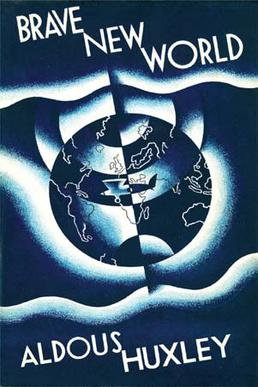
This certainly seems to apply to Brave New World. In the unlikely event you’ve never heard of it before, Brave New World is a dystopian novel by Aldous Huxley that imagines a highly controlled future society that emphasizes stability, consumerism, and immediate gratification. In some ways, Huxley’s imagined world is clearly based on contemporary liberal criticisms. The logic of Henry Ford’s assembly line has been elevated to a religion. Consumerism is rampant (e.g. citizens are subliminally conditioned to buy new clothes instead of repairing old ones). Most obviously, notions of personal liberty are almost completely absent from this version of the future. On the other hand, this brave new world also bears clear resemblance to more conservative anxieties. Christianity has been abolished and virtually forgotten, to Huxley’s apparent vexation. Monogamy is also a thing of the past, and casual sex is shown to be harmful (at least for people from other cultures).

Adding to this confusion is the willy-nilly way Huxley drops references. Two of the main characters are named Marx and Lenin(a), and I spent much of the book trying to puzzle out their connection to communism. There’s an off-handed mention of a character named Bakunin, but no further reference to the anarchist philosophy traditionally associated with that name. Some characters’ names are double-barreled references, and sometimes these make some sense. The improbably named Helmholtz Watson is a reference to two foundational psychologists, the latter of whom has his most famous experiment clearly referenced in the book (though this part of the book has nothing to do with the character of Helmholtz Watson). Other times these dual reference seem more like Mad Libs, as in the cases of Benito Hoover and Darwin Bonaparte.

A friend suggested that there’s no one-to-one between characters and their namesakes. Instead, the namedrops as a whole are meant to point to the ideas and trends that were on Huxley’s mind as he was writing. I think that’s probably right. But I’m less inclined to interpret Huxley’s melange of dystopian tropes as neutral observation. I think he was pointing to elements in society he disliked and showing the consequences of leaving those elements unchecked. (Reading about the history of the book on Wikipedia seems to support my idea.)

So reading this book challenged me, in a way I appreciated. I had to actually reflect on my own ideas in depth, instead of mentally stamping the whole book with “Agree” or “Disagree.” I was impressed with the way Huxley predicted the neoliberal drive for a frictionless workforce, and I appreciated his criticisms2. At the same time, I balked at his yearning for widespread, chaste monogamy. Huxley doesn’t resort to strawmen. Near the end of the book a character gives an articulate, persuasive defense of his society, pointing out that much of what others find objectionable boils down to different choices of what to value.

I was also impressed with aspects of Huxley’s world building. Helicopters hadn’t even been invented at the time he wrote the book, but he predicted they would be widely used in the future. (Which is true, even if we don’t have personal helicopters in the way he predicted). Cheap, narcotic entertainment (including pornography), a major element of Huxley’s new world, has also come to pass. His idea of causing a zygote to “bud” into many identical clones is couched in plausible terms, and his treatment of artificial gestation has more lately been taken up by authors as influential as Lois McMaster Bujold. Finally, the audiobook I listened to was read by Michael York, and his narration did an incredible job driving home the wit in Huxley’s words.

  1. I use the term “blame” because I think lots of people, including myself, assume that such blatancy is a bad thing. But maybe making clear political statements can be a good thing, for example when there is an urgent and high stakes problem. If this is true, levels of blatant political messaging is less likely to vary based on historical period and more likely to vary based on how important the author thinks their message is. ↩︎
  2. Brave New World is often compared to Nineteen Eighty-Four, by George Orwell, and the comparisons are often framed in terms of which author was more correct. It’s a fun game, but probably not the best way to think about the issue. However, I do want to highlight one thing I think Orwell observed that is lacking from Huxley’s work, namely, abuse of power. The “world controller” we meet in Brave New World is a quaint academic. He allows himself some indulgences forbidden to others (say, reading Shakespeare) but is sincerely committed to serving the population, whose values he shares. In Nineteen Eighty-Four, the authorities are driven by power. They seem themselves as separate from, and above, the general population. They influence how the population thinks and acts not out of beneficence but purely to entrench their own status. In this aspect, I find Orwell much closer to the mark. ↩︎
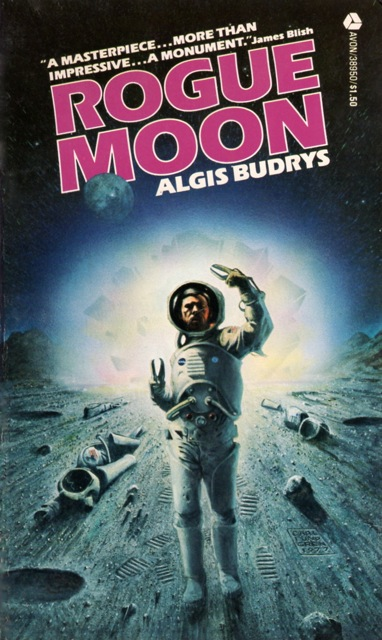
Book Review: Rogue Moon, by Algis Budrys

I picked up Rogue Moon because of the following description on Wikipedia: “Rogue Moon is largely about the discovery and investigation of a large alien artifact found on the surface of the Moon. The object eventually kills its explorers in various ways”. The book ended up not quite living up to that description, but it was interesting nonetheless.

I found Budrys’ prose to be a bit difficult, for better and for worse. I got the sense he was really striving for something literary, carefully (and at times, slightly awkwardly) applying rules like the classic “show don’t tell.” A character’s emotions, for example, are often implied by how other characters react to them. He mostly succeeds in this attempt, which combines nicely with his efforts to explore the psychology of brilliant and complicated men (and one woman). But he often leaves the scenery under-described. Aside from the almost compulsive descriptions of each man’s face, I often could not picture a given scene, and I was sometimes briefly startled when a new character or device, apparently there the whole time, materialized into relevance. But as these things usually go, I got used to the style after 50 or so pages.

The story takes place in 1959. Satellite reconnaissance has revealed a strange structure on the surface of the moon. The US Navy recruits Dr. Edward Hawks to help them investigate. While manned space flight is still slightly out of reach, Dr. Hawks has been developing a transporter device that scans an object and flawlessly reconstructs it at a receiving station. One of these receiving stations is dropped on the moon, and people are sent up there to to explore the structure. The research team discovers that when humans are replicated, they can perceive what the other one is experiencing so long as they don’t have competing sensations. So the earth versions of the explorers are kept in sensory deprivation while their lunar counterparts investigate the the mysterious structure. Unfortunately, each of the explorers dies almost immediately upon entering the structure, and each of them in highly unusual ways. This has the unfortunate side effect of driving their earth counterparts insane.

So far that’s mostly like the description above, except that all of that takes place before the opening of the book. Budrys spends the vast majority of the short novel looking at the interactions between earthbound characters. Chief among these are the interactions between Hawks and rugged adventurer Al Barker. Barker is recruited to the project because he seems to court death, so maybe experiencing his duplicate dying won’t make him insane. Consistent with his attempts at literary style, Budrys seemed to have Big Things to say about death, but I mostly didn’t find them interesting. Anyway, Hawks and Barker get on like cats and dogs, and they’re surrounded by conniving, egotistical schemers.

Themes

Hyper-competent protagonist: It’s common for science fiction stories to have genius, athletic, heroic, hyper-competent protagonists. This is especially true from works by authors who spent time writing for pulp magazines, as Budrys did1. He doesn’t fully deconstruct that trope here, but he goes a lot further than many authors in suggesting that such protagonists might actually be pretty complicated under the hood.

Women as sexpots: When mid-century science fiction (written by men) noticed women at all, it was to portray them as sexual objects. In Rogue Moon, Al Barker has a sexy and flirtatious girlfriend, Claire, who seems like she’s constantly on the prowl. Lots of description is lavished on her legs and hips and neck. But later in the book, Claire reveals she has insight to her histrionic behavior, but doesn’t know how to change it. She’s contrasted with Elizabeth, a woman who Hawks starts dating. Elizabeth is basically just a normal person (imagine that!). I don’t know that Rogue Moon gets a gold star for feminism, but it’s more nuanced than a lot of its contemporaries.

Danger Zone: Though this aspect of the book was less central than I would have liked, Rogue Moon seems important to the lineage of the “dangerous, unexplainable zone” trope. (That trope is more famously represented by stories like Roadside Picnic and Annihilation.) Hawks gives the following description, which I love:

“We don’t even know what to call that place. The eye won’t follow it, and photographs convey only the most fragile impression. There is reason to suspect it exists in more than three spatial dimensions. Nobody knows what it is, why it’s located there, what its true purpose might be, or what created it. We don’t know whether it’s animal, vegetable, or mineral. We don’t know whether it’s somehow natural, or artificial. We know, from the geology of several meteorite craters that have heaped rubble against its sides, that it’s been there for, at the very least, a million years. And we know what it does now: it kills people.”

At the end of Rogue Moon, we do get more detail about Barker navigating the labyrinth and the strange, seemingly arbitrary ways in which it kills him. It’s fascinating and spooky stuff.

Transporter Problem: The Transporter Problem, or “Teletransportation paradox” states that if a person could be teleported, it is not clear if the person coming out the ending teleporter is literally the same person who went into the starting teleporter, of if they are just an identical clone with the same memories2. This is often discussed in relation to Star Trek, and various philosophers have quipped they would never use Star Trek style transporters because it would effectively kill them and replace them with a doppelganger. Rogue Moon starts from assumption that the replica is *not* you, and uses that to ask questions about identity and death.

The book has enough interesting things to think about in its short span to be worthwhile. It just doesn’t scratch that spooky, cosmic horror adjacent itch I was hoping for.

  1. Rogue Moon actually started as a novella published in The Magazine of Fantasy and Science Fiction. ↩︎
  2. Of course, that’s begging the question a bit. Would an identical clone with the same memories automatically count as being the same person? That’s one of the layers to the thought experiment. ↩︎

Pulp Trivia

I’ve been reading a ton of Wikipedia articles about pulp authors for a writing project I assigned myself. I’ll share that project here when it’s done. But in the meantime I’ve come across a lot of fun trivia I want to share.

Jack Williamson was old enough to be born in Arizona Territory, and lived long enough to see some of his science fiction ideas pass into reality. He was one of the very first people to use the term “genetic engineering,” and he was the first science fiction writer to include ion thrusters in a story. He was an early science fiction writer to discuss antimatter (though he referred to it by its older name, contraterrene). And he coined the terms “psionics” and “terraforming”.

Williamson also has one of the best examples of failing upwards that I’ve ever seen. His novel Seetee Ship was negatively reviewed, including a line that said it “ranks only slightly above that of a comic strip adventure.” That review somehow got noticed by The New York Sunday News, which was looking for someone to write a new comic strip for them. They ended up hiring Williamson to write a loose adaptation of his poorly reviewed novel.

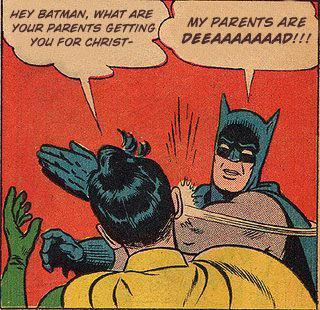
Edmond Hamilton wrote for pulp magazines and comic books. He wrote the Batman story that featured the now meme-famous panel of Batman slapping Robin.

The first person to use the term “blaster” to refer to a sci-fi gun was named Nictzin Dyalhis. Or at least that might have been his name. Apparently he was an intensely private man and routinely lied about his biographical details, including on government forms.

The woman who invented dark fantasy, Gertrude Barrows Bennett, was widowed when her husband was caught in a tropical storm while on a treasure hunting expedition. It’s crazy to me that “professional treasure hunter” was a real job someone claimed in 1910. Anyway, Bennett turned to writing as one means of supporting herself and her children, and became very influential in the process. She is probably the first female American author to publish science fiction under her own name.

Bennett is the first (American, female, science fiction) author to publish under her own name because she published a single story in 1904 as G. M. Barrows, which was her name at the time. However, her gender wasn’t revealed until four years after her death, and she spent most of her career writing under the pseudonym Francis Stevens. The first female science fiction author to consistently publish under her own name was Clare Winger Harris.

Greye La Spina was another early female pulp writer. Apparently at her peak she was even more famous than H. P. Lovecraft.

Interesting Wikipedia Articles I’ve Read Recently

Ziz: I was vaguely aware that the term “leviathan” referred to a creature with biblical-ish origins. And while I knew the word “behemoth,” I didn’t know it referred to a specific (fictional) creature, also from Jewish mythology. What I definitely didn’t know is that the leviathan and behemoth have an airborne cousin, the ziz. It is a bird said to be so huge that it can stand on the floor of the ocean with the water only reaching its ankles, and it lays eggs so massive that if they crack open they’ll flood sixty cities.

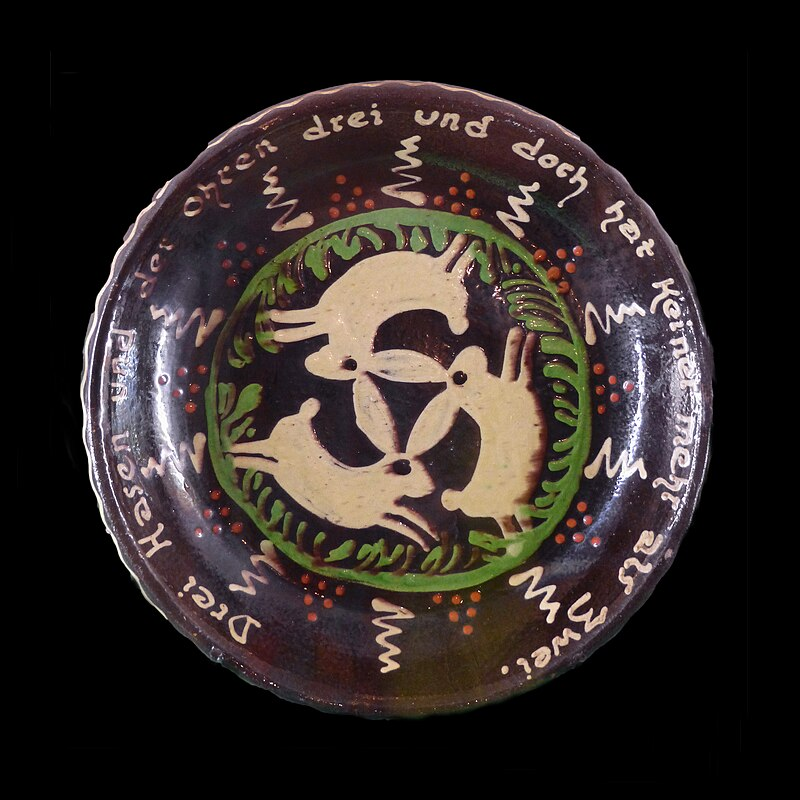
Three Hares: This is such a neat factoid I’m surprised I’ve never heard about it before. There’s a very specific art motif that features three rabbits arranged in a circle such that their ears are overlapping, and this symbol has popped up through through vast spans of time and space. The earliest examples we know of came from Chinese caves between the years 500 and 700. Later, the symbol appears in Islamic art in the late 1200s to early 1300s. Later still, it appears in western Europe, and even becomes particularly prevalent in the churches of southwestern England. There’s a theory that the symbol gradually diffused out of China along the “silk road” trading route. (For reasons I can’t really explain, this is my favorite hypothesis.) Others guess that the motif rose at least partially independently, and point out a long history of similar symbols in Celtic culture. One of the fun things about the Wikipedia article is reading all the different meanings the symbol had across times and places: everything from water to luck to the holy trinity to the Jewish diaspora.

Peter Lamborn Wilson: I came across Wilson as the person who coined the term “temporary autonomous zone” (TAZ). It’s a kinda useful, kinda fun idea about how we can make spaces that are mostly free of social control and use them to experiment with different ways of being. TAZs still get talked about a fair amount in anarchist circles, from what I can tell, though sometimes with some some caveats about Wilson’s personal life. In reading out his life on Wikipedia, two things jump out at me.

First the big one: apparently he also wrote for NAMBLA? I haven’t tracked down those writings and don’t care to, but they have been characterized by others (including Wilson’s former friends) as promoting sex between adults and children. So that fucking sucks. It’s weird how often this sort of thing crops up. Science fiction grand master Samuel Delany is a queer champion but also a supporter of NAMBLA1. (Both Wilson and Delany have had criticisms and mentions of pedophilia downplayed in their Wikipedia articles in the last year, which is disturbing). As this great thread on /r/AskHistorians points out, philosophers like Michel Foucault and Jean-Paul Sartre signed a petition against age of consent laws. I think you find predators in every walk of life, and they often manipulate whatever ideas they have at their disposal to persuade others2.

Second, Wilson was seemingly obsessed with other cultures, particularly Islam. That’s always a phenomenon that interests me. On one end of the respectability spectrum, you have have college professors and anthropologists who specialize in this or that. At the other end, you have folks like Iron Eyes Cody or Rachel Dolezal who engage in 24-7 cosplay as a member of a different group. Wilson didn’t quite go that far, but he did convert his religion and produce a lot of his writing under an ethnic pen name. I want to better understand why people get involved with that sort of cultural adoption. That means I’ll probably mentally bookmark Wilson as a case study but never look much further because focused research isn’t actually fun for me.

Anyway, TAZs are a cool concept. I think it’s important to recognize value in social experiments even if they don’t last for a long time.

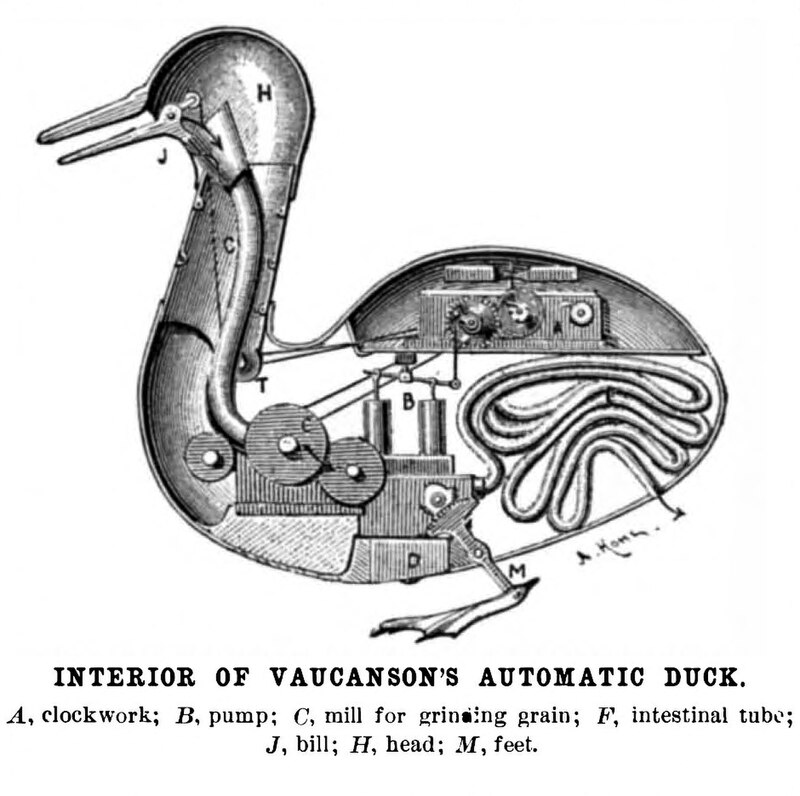
Digesting Duck: When I was in middle or high school, I read about an art instillation where some weirdo built a complex machine that mimicked human digestion. Food would be pushed in one end, get processed, and exit the other end as artificially-made shit3. The shits would then be vacuum sealed and sold to art collectors4. Anyway, the artist was (knowingly or not) working in conversation with Jacques de Vaucanson, a 1700s French inventor who created various machines and automata, including a mechanical duck that “ate” food out of the operator’s hand. Then, through some jiggery-pokery, the brass duck would appear to poop out the remains of the food. In reality, the food went into an internal pouch, while the “poop” (small, balled-up pieces of bread that were dyed green) were pre-loaded in a separate pouch. People at the time went gaga for the fake metal poop machine. The duck was lost in a fire, but has a robust afterlife making cameos in literature by everyone from Nathaniel Hawthorne to Frank Herbert.

  1. There’s a complex history between queer folks and organizations like NAMBLA that is beyond the scope of my knowledge but which surely provides important context. ↩︎
  2. According to the scant information on Wikipedia, there’s no evidence that Wilson abused children himself. Whether he was persuaded to his views by an abuser or came to them himself I don’t know. ↩︎
  3. Arguably an early example of machines taking over creative jobs. If you’re anti-AI, you shouldn’t settle for anything less than the real thing (SFW link, except for language). ↩︎
  4. The jokes write themselves. ↩︎

“Reading Weird Fiction in an Age of Fascism”

Over at Ancillary Review of Books (which I was previously unfamiliar with, but which I will be checking out more now), Zachary Gillan (ditto previous parenthetical) published a very good essay entitled “Reading Weird Fiction in an Age of Fascism.”

Essays that argue about the political content of various genres (e.g. fairy tales are inherently feminist / antifeminist) can be a little interesting, but they usually read like fan theories for self-important academics. Gillan elides this by instead asking how an antifascist might mine weird fiction for lessons / tools, were she so inclined. I find this approach way more palatable.

It boils down, I think, to two axioms:

  1. To become radical, politically, is to become aware that the dominant ideology shaping the way we view the world is Wrong, and needs revolutionary change from the root. 
  2. To be a character in a work of weird fiction is to see that the world is Wrong; whatever direction the author takes this sense of Wrongness, weird fiction hinges on a radical shift in awareness (Some weird fiction channels that sense of unsettlement into the awe-inspiring sublime or fascinating numinous; this is not the kind of weird fiction that I’m considering here.)

He goes on to elaborate on these ideas in clear and persuasive prose. Right near the end things get a little tedious as he quotes people who quote Marx. But overall I really liked this.

Anti-Human Horror

Cosmic horror, I think, is predicated on imagining a sort of “anti-human” universe. All horror is probably anti-human to some degree. Monsters and slashers want to kill or hurt humans, or violate their desires in some way. But cosmic horror goes several steps further. It imagines that the fundamental makeup of reality is intractable to human analysis. This is why Lovecraft’s protagonists often go insane. The universe is under no obligation to make sense; in fact, trying to make sense of it might be poisonous.

I was talking to my partner recently and realized that folk horror actually posits something similar. Folk horror is a big, nebulous term (much like cosmic horror, I suppose). Right now I mean the aspects of folk horror that emphasize the scariness of nature and ancient “pagan” rituals that were somehow more in tune with nature than modern civilization. These stories agree that reality isn’t human-centric, but brings the idea closer to home. Instead of encouraging us to imagine abstract physical laws or the vacuum of deep space, it invites us to imagine a forest. We don’t need to travel billions of years before we leave the familiar behind- one or two thousand will do the trick nicely.

And in thinking about this, it also brings to mind the stories of Franz Kafka, especially his hand-wringing about dehumanizing bureaucracies. Cosmic horror suggests that the universe, writ large, is incomprehensible and noxious to humans. Folk horror (at least some folk horror) says even the nature close at hand is antithetical to humans, though this effect is probably exacerbated by modern life1. And Kafka confirms the folk horror thesis by showing how modern society breeds neuroses and alienation.

All this sort of makes me think of a telescoping taxonomy, sort of like how physics contains chemistry, which in turn contains biology. But it also makes me think about how humans are pretty good at imagining themselves as separate from things. The universe isn’t for us, and nature isn’t for us, and society isn’t for us. Oh no, where to turn! But I think these impressions only hold if your starting point is to imagine the world as highly anthropomorphic and deliberate and good, with humans holding dominion over it all. In other words, these ideas are scary in the context of a a particular kind of Christian worldview. There’s a reason cosmic horror has a strong anti-Christian subtext, and it’s the same reason folk horror often pits Christianity against paganism. (I don’t remember Christianity being a strong theme in Kafka’s works, but it’s been a while since I’ve read him.)

Actually, in all of the above cases, the “thing” that isn’t for us is just stuff that we’re already part of. How could the universe not be for us when we’re clearly part of the universe? It’s like imagining the ocean isn’t “for” fish because fish can still die in the ocean. The same goes for our place in nature2 and society. Anti-human horror is great at blowing up a sort of western, Christian, Victorian worldview, but it’s not so good at replacing that worldview. For that, we need to understand continuousness between ourselves and the systems with exist inside.

  1. For example, think about the commune in Midsommar (2019). They still have to deal with tragedy and death like everyone else, but the have found an older way of living that mitigates some of the suffering that comes with the territory. ↩︎
  2. One of my pet peeves is the way people talk about nature as some concept with a tortuous boundary that excludes everything humans do, but includes all activities of all other animals. Defining nature as “stuff that doesn’t have to do with humans” is useful in some contexts, but it reinforces this concept that humans are somehow separate from the world around them. ↩︎