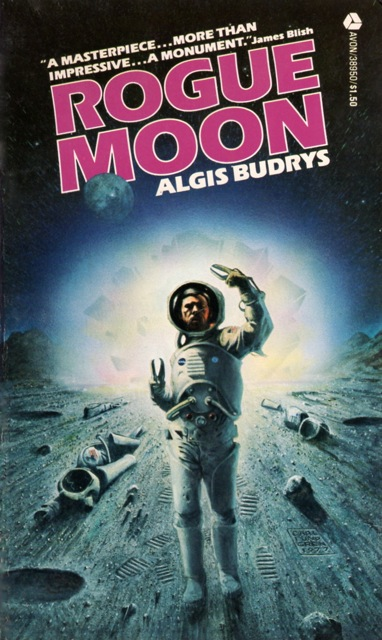
I picked up Rogue Moon because of the following description on Wikipedia: “Rogue Moon is largely about the discovery and investigation of a large alien artifact found on the surface of the Moon. The object eventually kills its explorers in various ways”. The book ended up not quite living up to that description, but it was interesting nonetheless.
I found Budrys’ prose to be a bit difficult, for better and for worse. I got the sense he was really striving for something literary, carefully (and at times, slightly awkwardly) applying rules like the classic “show don’t tell.” A character’s emotions, for example, are often implied by how other characters react to them. He mostly succeeds in this attempt, which combines nicely with his efforts to explore the psychology of brilliant and complicated men (and one woman). But he often leaves the scenery under-described. Aside from the almost compulsive descriptions of each man’s face, I often could not picture a given scene, and I was sometimes briefly startled when a new character or device, apparently there the whole time, materialized into relevance. But as these things usually go, I got used to the style after 50 or so pages.
The story takes place in 1959. Satellite reconnaissance has revealed a strange structure on the surface of the moon. The US Navy recruits Dr. Edward Hawks to help them investigate. While manned space flight is still slightly out of reach, Dr. Hawks has been developing a transporter device that scans an object and flawlessly reconstructs it at a receiving station. One of these receiving stations is dropped on the moon, and people are sent up there to to explore the structure. The research team discovers that when humans are replicated, they can perceive what the other one is experiencing so long as they don’t have competing sensations. So the earth versions of the explorers are kept in sensory deprivation while their lunar counterparts investigate the the mysterious structure. Unfortunately, each of the explorers dies almost immediately upon entering the structure, and each of them in highly unusual ways. This has the unfortunate side effect of driving their earth counterparts insane.
So far that’s mostly like the description above, except that all of that takes place before the opening of the book. Budrys spends the vast majority of the short novel looking at the interactions between earthbound characters. Chief among these are the interactions between Hawks and rugged adventurer Al Barker. Barker is recruited to the project because he seems to court death, so maybe experiencing his duplicate dying won’t make him insane. Consistent with his attempts at literary style, Budrys seemed to have Big Things to say about death, but I mostly didn’t find them interesting. Anyway, Hawks and Barker get on like cats and dogs, and they’re surrounded by conniving, egotistical schemers.
Themes
Hyper-competent protagonist: It’s common for science fiction stories to have genius, athletic, heroic, hyper-competent protagonists. This is especially true from works by authors who spent time writing for pulp magazines, as Budrys did1. He doesn’t fully deconstruct that trope here, but he goes a lot further than many authors in suggesting that such protagonists might actually be pretty complicated under the hood.
Women as sexpots: When mid-century science fiction (written by men) noticed women at all, it was to portray them as sexual objects. In Rogue Moon, Al Barker has a sexy and flirtatious girlfriend, Claire, who seems like she’s constantly on the prowl. Lots of description is lavished on her legs and hips and neck. But later in the book, Claire reveals she has insight to her histrionic behavior, but doesn’t know how to change it. She’s contrasted with Elizabeth, a woman who Hawks starts dating. Elizabeth is basically just a normal person (imagine that!). I don’t know that Rogue Moon gets a gold star for feminism, but it’s more nuanced than a lot of its contemporaries.
Danger Zone: Though this aspect of the book was less central than I would have liked, Rogue Moon seems important to the lineage of the “dangerous, unexplainable zone” trope. (That trope is more famously represented by stories like Roadside Picnic and Annihilation.) Hawks gives the following description, which I love:
“We don’t even know what to call that place. The eye won’t follow it, and photographs convey only the most fragile impression. There is reason to suspect it exists in more than three spatial dimensions. Nobody knows what it is, why it’s located there, what its true purpose might be, or what created it. We don’t know whether it’s animal, vegetable, or mineral. We don’t know whether it’s somehow natural, or artificial. We know, from the geology of several meteorite craters that have heaped rubble against its sides, that it’s been there for, at the very least, a million years. And we know what it does now: it kills people.”
At the end of Rogue Moon, we do get more detail about Barker navigating the labyrinth and the strange, seemingly arbitrary ways in which it kills him. It’s fascinating and spooky stuff.
Transporter Problem: The Transporter Problem, or “Teletransportation paradox” states that if a person could be teleported, it is not clear if the person coming out the ending teleporter is literally the same person who went into the starting teleporter, of if they are just an identical clone with the same memories2. This is often discussed in relation to Star Trek, and various philosophers have quipped they would never use Star Trek style transporters because it would effectively kill them and replace them with a doppelganger. Rogue Moon starts from assumption that the replica is *not* you, and uses that to ask questions about identity and death.
The book has enough interesting things to think about in its short span to be worthwhile. It just doesn’t scratch that spooky, cosmic horror adjacent itch I was hoping for.